
For Reels & Shorts creators, UGC creators and editors
Fix your Reel before you post it.
Upload a Reel, Short or voice-over. In about a minute you get an edit plan: what to fix first, the second it happens and the frame it happens on.
- Your first reads are free, no card or UPI needed
- Plans from ₹149, pay by UPI, no AutoPay

Second by second
Craft score
It keeps moving and has real peaks, but the opening is the weak spot: first word at 4.8 s.
Fix first
- 1
Start talking sooner — the first word lands at 4.8 s. Trim the lead-in so it lands under 1 s.
Now first word at 4.8 s · Aim under 1 s
Hook+5.6 to the score - 2
Front-load the energy — the opening is calmer than the rest. Tease the peak at 0:08 in the first seconds.
Now opening at 56% of the clip's typical intensity · Aim 100% or more
Hook+5.6 to the score
How it works
Three steps, about a minute.
- 1
Drop a clip
Video or audio — mp4, mov, webm, mp3, wav. Anything longer than three minutes, you pick the section to read.
- 2
Every second is measured
Cuts, motion, faces and expressions; speech, pace, pitch, music, beat and loudness. Each measurement is tested against clips with a known answer.
- 3
Get the edit plan
Each fix with its frame, its second and the part it lifts, in the order a viewer meets the problems. The Craft score sits on top.
What it checks
Eight of the 39 signals it reads on every clip.
A read measures 39 signals a second and scores 16 checks from them, then an AI reads the story. These eight, drawn from the same 22-second example, are the ones you can see at a glance.
First word
4.8 s
Cuts and motion
9 cuts
Faces
64% of seconds
Dead air and still stretches
0 s dead · still 9%
Loudness
-14 LUFS
Pace and voice
5.7 syl/s · 3.8 st
New moments
6.8 per 10 s
Peaks
high point at 0:08
The Craft score
Four parts, one score.
Hook, Hold and Feel are measured from the file. Story is an AI read that lands about a minute later. The score averages the parts a clip has.
Hook
measuredDo the first seconds give people a reason to stay?
Hold
measuredDoes something keep happening, with no dead air or long still stretches?
Feel
measuredDoes it rise and fall, with expressive delivery and a clear high point?
Story
AI readDoes it promise, pay off and land, judged from what is said and shown?
Re-check
Edit, then check v2.
Made the edits? Upload the new cut. The re-check shows the score before and after, part by part, and which planned edits landed.
- v1
Read your cut
Get the edit plan: each fix at its second, on its frame.
- Edit
Make the fixes
Tick each one off in the plan as you go.
- v2
Re-check the new cut
Before and after, part by part, and which planned edits landed.
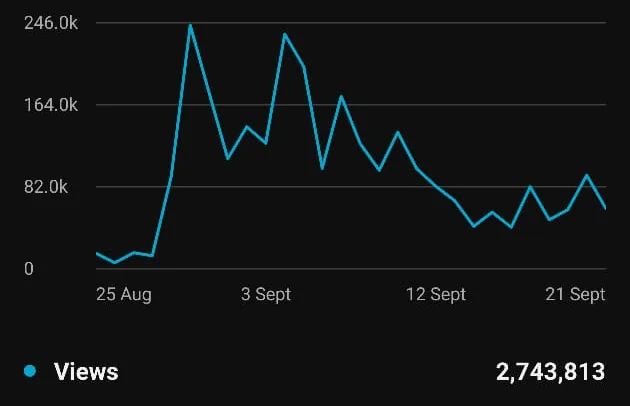
Our test channel
5.6M views in about 2 months.
Before launch, we ran an early version on a Shorts channel we started from zero. Every Short was checked before it went up.
- hours watched, same two months
- 30.2K
- hours watched, same two months
- subscribers, from zero
- 3,122
- subscribers, from zero
Our own channel. Its name and videos are withheld.
Who it is for
Built for the edit before you post.
Reels & Shorts creators
Finance, food, fitness, comedy, devotional, coaching: catch the slow opening and the dead spots before you post.
Read the guideUGC creators
Send the brand a tighter cut: first word on time, no dead air, steady sound — before they ask for a redo.
Read the guideFreelance reel editors
Check a cut before the client sees it, fix it, then re-check v2. Fewer 'it feels slow' revision rounds.
Read the guideTeachers, coaches and podcasters
Explainers and podcast clips: find the long pauses and the flat stretches. Audio-only works too.
Read the guide
Editing team, agency, YouTuber, ad team or film team? See how it can fit your work
Measured, tested, plain about its limits
Why the numbers hold up.
Tested against known answers
Every measurement is checked against clips built so the right answer is known. The checks are part of the product's test suite.
- A metronome at 120 BPM
- reads 120 BPM
- A test tone, white noise, chords
- read 0% speech
- A camera panning across a still scene
- reads as a camera move, not a moving subject
- The same voice 6 dB quieter
- reads the same pace, pitch and speech share
Same file, same measured score
Hook, Hold and Feel are measured, so the same file gets the same numbers every time. Story is an AI read at a fixed setting and only one of the parts averaged, so it cannot swing the score on its own.
Not a brain scan
The 3D brain in a result is a model of the measured signals — a way to see them, not a recording of anyone's brain.
Missing is never zero
No faces in a clip, no speech, or expression reading switched off: those checks are left out and named, never scored as a failure.
Questions
Asked, answered.
What is NeuroVidz?
A tool that reads a video or audio clip second by second — what is in the picture and what is in the sound — and scores how well it hooks, holds and moves a viewer, with the exact edits to make, each pinned to a timestamp.
How does it work?
It measures 39 signals every second — cuts, motion, faces and expressions, speech, pace, pitch, music, beat and loudness — and checks them against what keeps people watching: a fast start, no dead air, something new every few seconds, a clear high point. A language model then answers seven plain questions about the story. Every part of the score shows what it measured.
Which platforms does it work for?
Any. It reads the video or audio file itself, so it does not matter where the file is going: Instagram, YouTube, Facebook, LinkedIn, an ad or a client. There is no account to connect and nothing is posted anywhere. You get the read before you publish, while you can still change the edit. Platform analytics only arrive after the video is live.
How is the score calculated?
Hook, Hold and Feel are measured from the file. Story is an AI read that lands about a minute later. The Craft score averages the parts a clip has, and each part is the average of its checks. Checks that cannot apply to your clip (no faces, no speech) are left out and named, never counted against it. The score describes how the clip is built; it does not promise views.
Does it predict views, or where viewers will drop off?
No. Nothing here forecasts views, reach or a retention curve: the topic, the timing and the audience decide those, after you post. NeuroVidz measures how the cut is built and marks the places viewers usually leave — a slow opening, a late first word, dead air, a long still stretch, a limp ending — at the second they happen, so you can fix them before posting. Instagram's own insights show real retention afterwards.
Is this a real brain scan or medically accurate?
No. Nothing is measured from anyone's brain. The score comes from the clip itself. The 3D brain in a result is a model of the measured signals, shown as a way to see them. None of it is medical, diagnostic or clinical.
Do you recognize people or store face data?
No. We detect faces only to read expression signals — we don't identify anyone or build facial-recognition templates, and face crops are discarded after processing. You can switch expression reading off in settings.
What happens to my video and data?
Your video is processed to produce the analysis and stored securely in your account. You stay in control — export or delete everything whenever you want.
What can I upload, and how long does it take?
Video or audio up to 400 MB (mp4, mov, webm, mp3, wav). Each read covers up to three minutes; drop a longer file and you pick which three minutes to read, right in the uploader. The edit plan lands in about a minute; the Story read follows about a minute later.
Can I export or delete my data?
Yes — anytime, from your account. Export downloads a copy of your data; delete permanently removes your videos and analyses.
Check your next Reel.
Your first reads are free, with no card or UPI needed to start. After that, plans from ₹149: prepaid like a recharge, paid by UPI, no AutoPay.
The edit plan lands in about a minute; the Story read follows about a minute later.
The example on this page is a real read of a 22-second voice-over reel, scored 76 on Hook, Hold and Feel with an earlier version of the checks. Story is not included.